
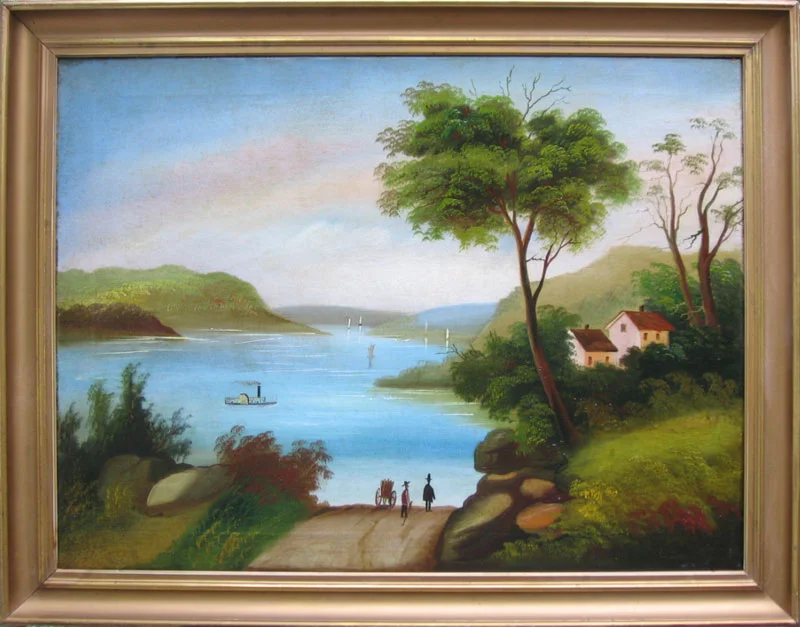
Waiting for the Steamboat
Oil on canvas, unsigned, c. 1850. Naive painting by an itinerant artist of the Hudson River School tradition. Canvas primed by the artist.
The painting is in an excellent state of preservation. No craquelature, yet no evidence of prior conservation. Our conservator, Fred Kozsewnik, performed gentle cleaning to remove the discolored natural resin varnish plus accumulated airborne soot and grime. He then applied a protective varnish and performed minimal inpainting and properly mounted the painting in the frame.
From an estate in Chester County, PA.
 SOLD
SOLD
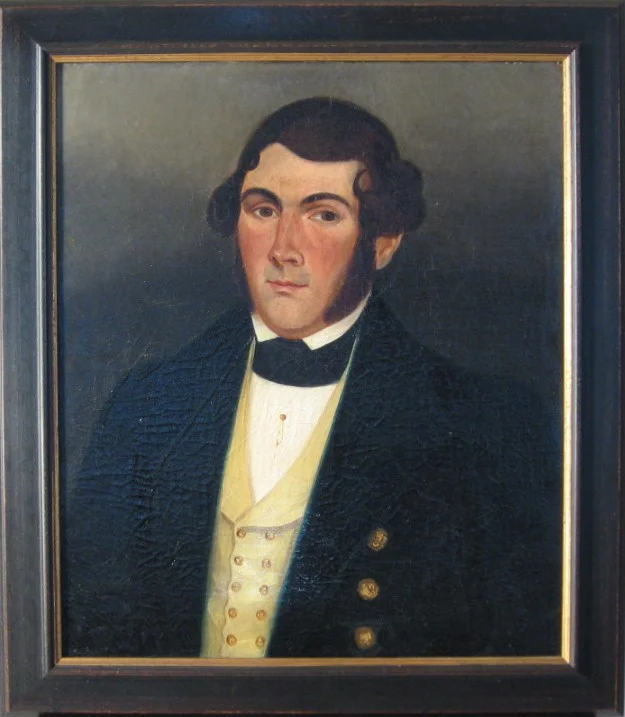
Joseph Alexander Main
Painted 1846, Joseph Alexander Main apprenticed with his father William Main, Master Mariner of Portsmouth, Southampton, England during the reign of King George IV.
He began his apprenticeship on December 16, 1821 at the age of 14 according to an original indenture (included). Also included is a Mariner’s registration ticket dated 1846. Other details such as his height (5’2”), brown hair, hazel eyes, and a rather dark complexion on the ticket bring this sitter to life.
SOLD
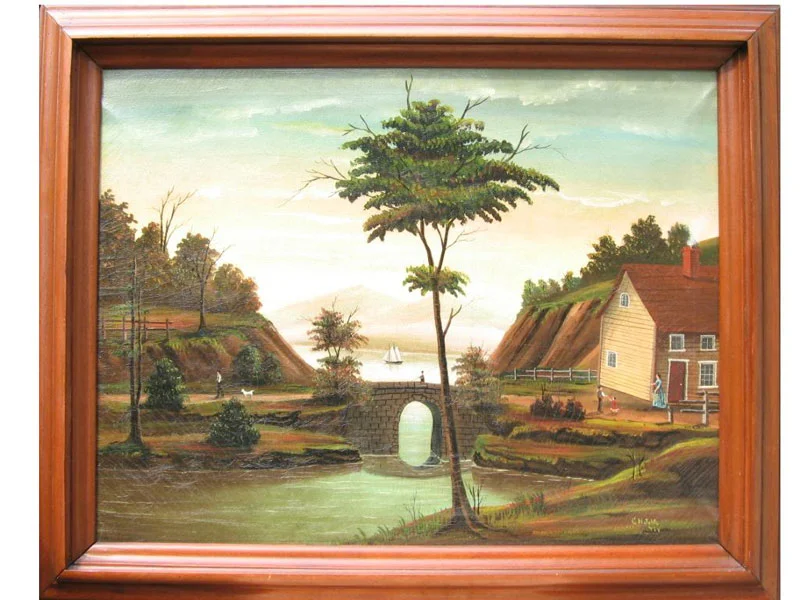
Hudson River Primitive Oil on Canvas, C H Jalfe -- c. 1850
Signed by itinerant painter C.H. Jalfe, this large naive landscape depicts an idealized view of the world. The luminous sky and abundance of water and mountains are all trademarks of the Hudson River School. Signed "C H Jalfe Ptr".
From the Meryl and Jay Weiss collection and Skinner, Boston.
Dimensions: 35"x 27" (painting); 43" x 36" (frame).
SOLD
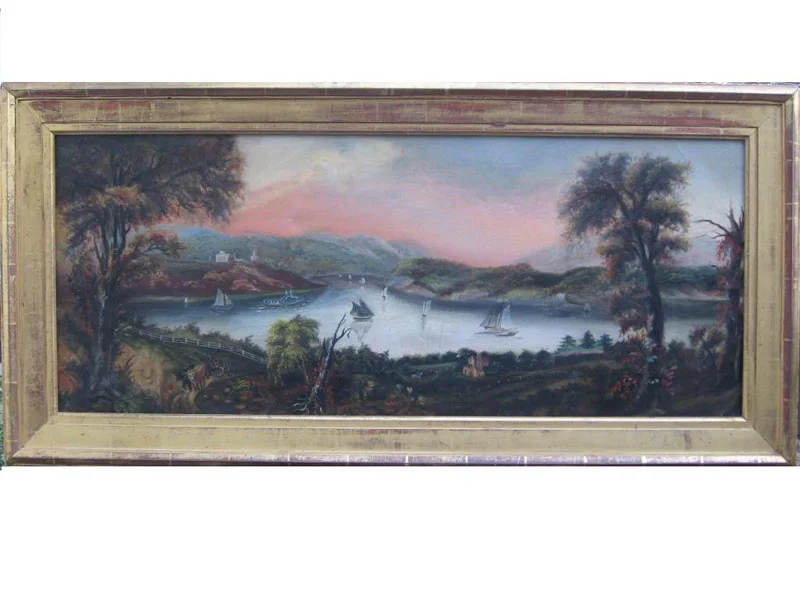
West Point on Hudson River--James Hope
Hudson River scene of West Point with sailboats, steamboat and buildings. From Bear Mountain, this is possibly the work of James Hope.
Dimensions: 16 x 38¾. (painting).
SOLD
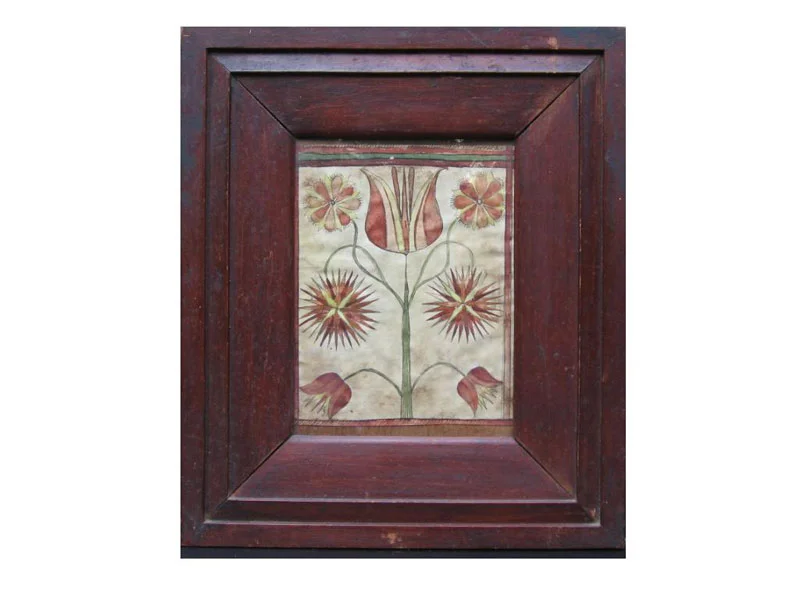
Pennsylvania German Fraktur
This fraktur is a fragile link to the Pennsylvania Germans of the 18th and 19th centuries. Likely a bookplate, these pure-art designs adorned the inside covers of books.
Watercolor and ink on paper. From an estate in Vermont.
Dimensions: 11 1/4" x 13 1/4" (frame).
SOLD
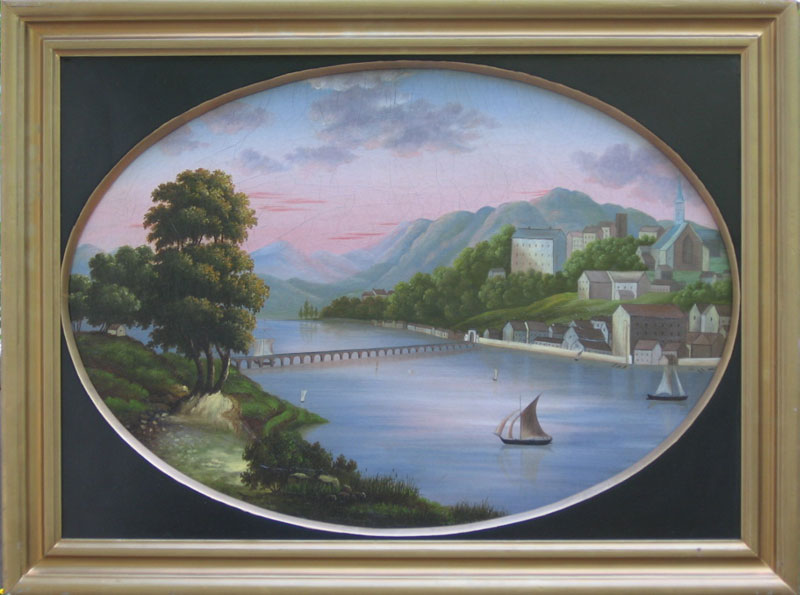
Harlem River Old Croton Aqueduct c. 1850
This popular scene captivated many in the mid-19th century. The bridge was a bold technical achievement both in solving water delivery to New York City and in the structure spanning the river. Clearly this scene is a fanciful rendition of that setting.
Dimensions: 28"W x 20"H (frame).
SOLD
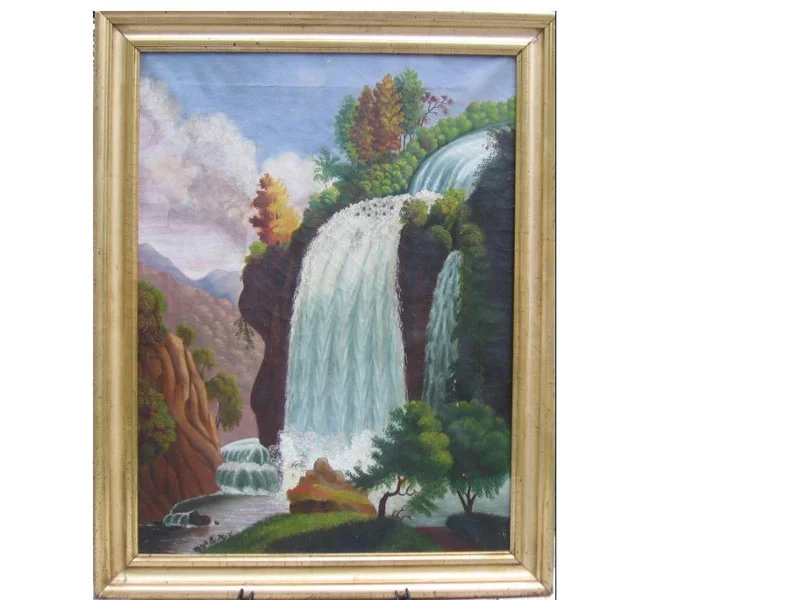
Hudson River Waterfall Landscape--c. 1860
This idyllic depiction of a lush Eden-like setting epitomizes 19th century naturalism. This untrained artist's imagination and skill created a remarkable scene of water flowing everywhere. The instability of the cliff, waterfalls and mountains do not inhibit this artist; rather the painter embraces it with exuberance. From an estate in Cazenovia, NY.
Dimensions: 18"x24" (painting).
SOLD
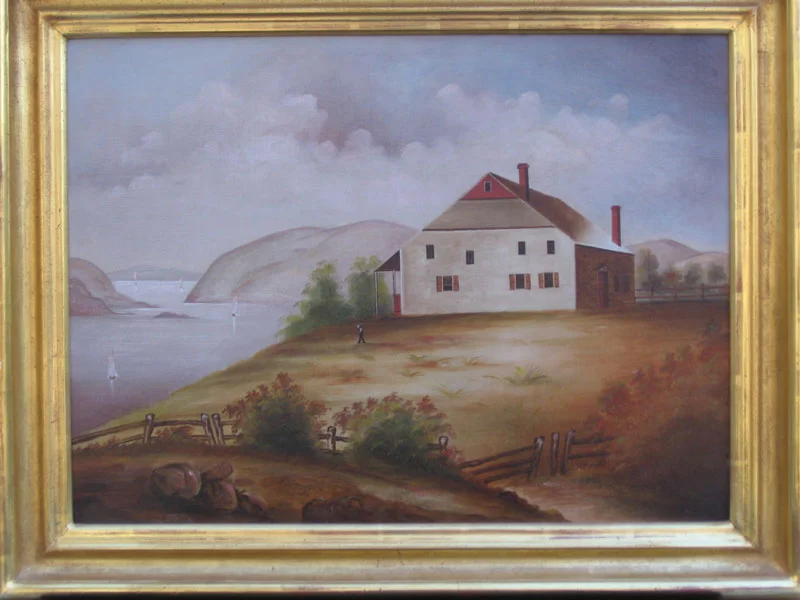
Washington at Newburgh
American School, late 19th century, “General George Washington’s Headquarters at Newburgh, New York”, 1893, oil on canvas, 18 in. x 24 in., framed (23 ½ x 29 ½).
This appealingly naive view of the Hasbrouck House, which Washington rented as his headquarters from April 1782 to August 1783, appears to be based primarily on an engraving by Joseph Andrews (1805-1873), after a drawing made on the site by John Ludlow Morton (1792-1871).
Jonathan Hasbrouck (1722-1780) and his wife Tryntje built this house in 1750. This traditional view southward down the Hudson River shows the north wall, with the single window of
Washington’s study (adjoining his bedroom) on the ground floor at left.
The above research was provided by Melvin Johnson, Washington’s Headquarters State Historic Site Assistant.
SOLD
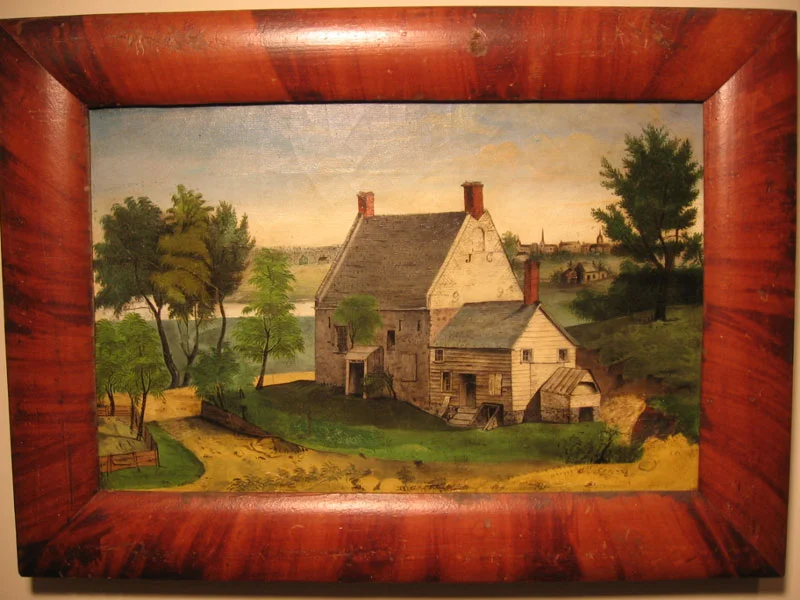
Vechte Cortelyou House
Naive landscape of the Vechte Cortelyou House in Brooklyn, New York.
The Old Stone House or Vechte Cortelyou House was built in 1699 by Claes Arentson Vechte. The house is located in Brooklyn, New York in the Park Slopes section, near the Gowanus Creek. The Vechte family farmed the land surrounding the home and also gathered oysters from the Gowanus Creek , pictured behind the home. The produce and oysters were then taken by boat to Manhattan to be sold at market.
This Dutch home is of historical significance. It was here that British troops used the house as an artillery position against the Americans during the Revolutionary War. This was the site of the first major battle after the Declaration of Independence was signed in 1776. The American troops suffered heavy losses and a major defeat at this location known as The Battle of Long Island or The Battle of Brooklyn.
Years after the Revolutionary War, the old stone house was sold to Jacques Cortelyou in 1797. Presumably, the initials JC stand for Jacques Cortelyou and 99 for the year in which the home was built, in 1699.
The house was destroyed by fire in 1897. It was reconstructed in 1930 in a somewhat different location. Part of the house was below 4 feet of earth due to fill dirt used in the construction of streets in Brooklyn. The house was rebuilt with these remains.
SOLD
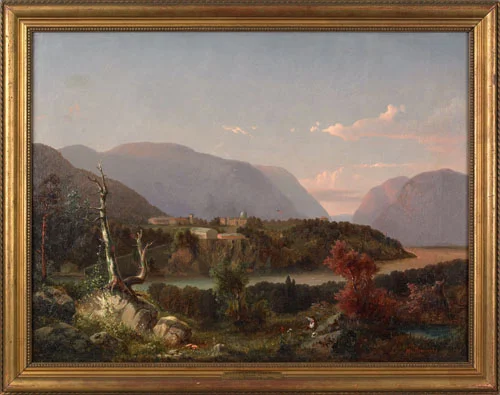
Otto Sommer "West Point-Hudson River"
Otto Sommer Oil on Canvas -- 1861 Hudson River School
A serene landscape of the famed West Point Academy with prominent American flag in the center. Otto Sommer (American, mid 19th c.), oil on canvas titled "West Point-Hudson River", signed lower right "Otto Sommer 1861". 24" x 32".
SOLD
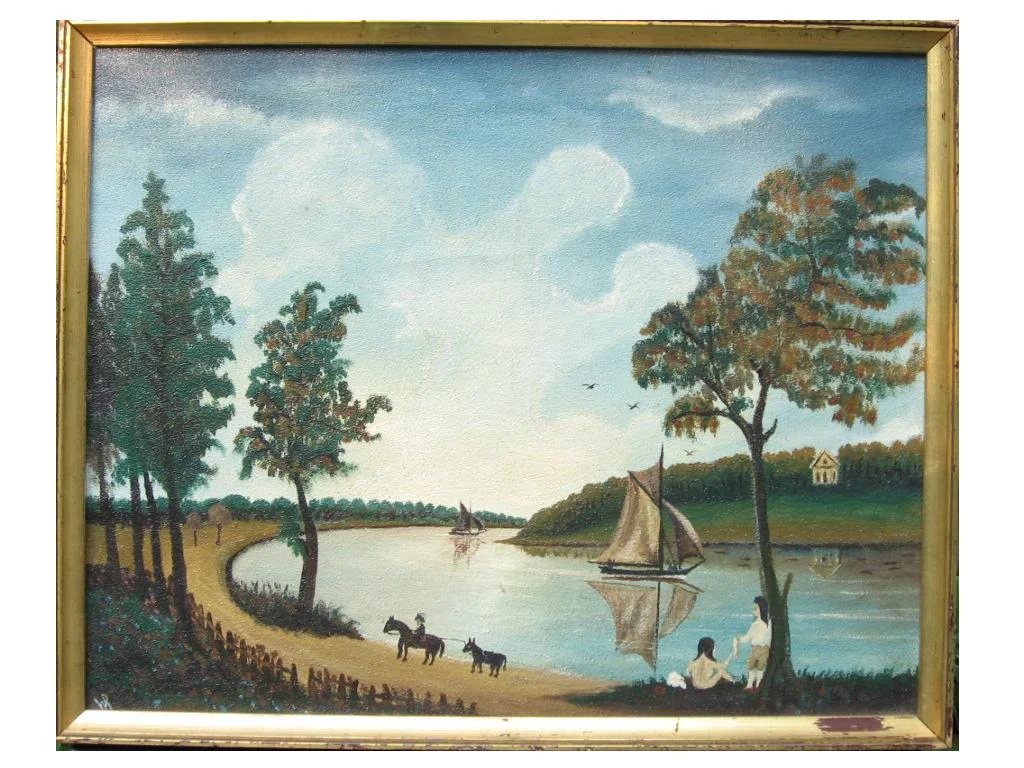
Bathers at River's Edge
Oil on textured base on canvas, monogrammed lower left "WR". A naive depiction of a river scene with sailboats, a horse and rider, and a house on the far shore. A young couple is on the near shore, and the woman is getting dressed after, presumably, a dip in the water.
Re-mounted on newer stretcher and frame. The paint is in a good state of preservation requiring no cleaning, stabilizing or inpainting.
Dimensions: 16"h. 20"w. (painting); 17 1/4"h. x 21 1/4" w (frame)
SOLD
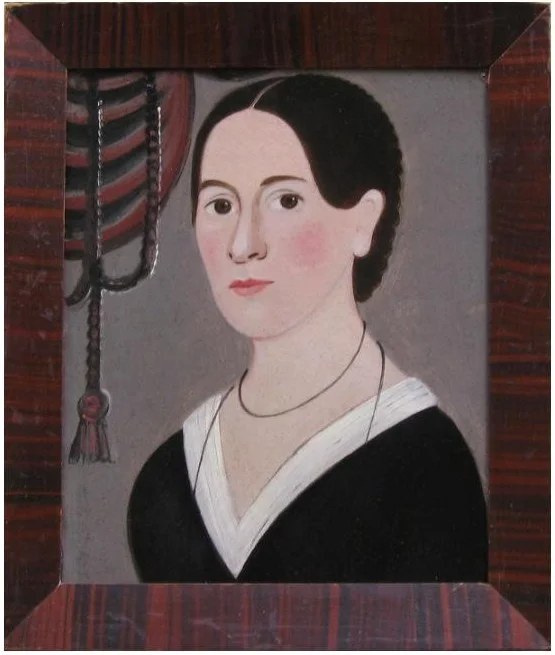
Prior-Hamblin Portrait of a Young Woman
SOLD